
A New Bracero Program?
By Daniela Garcia Perez
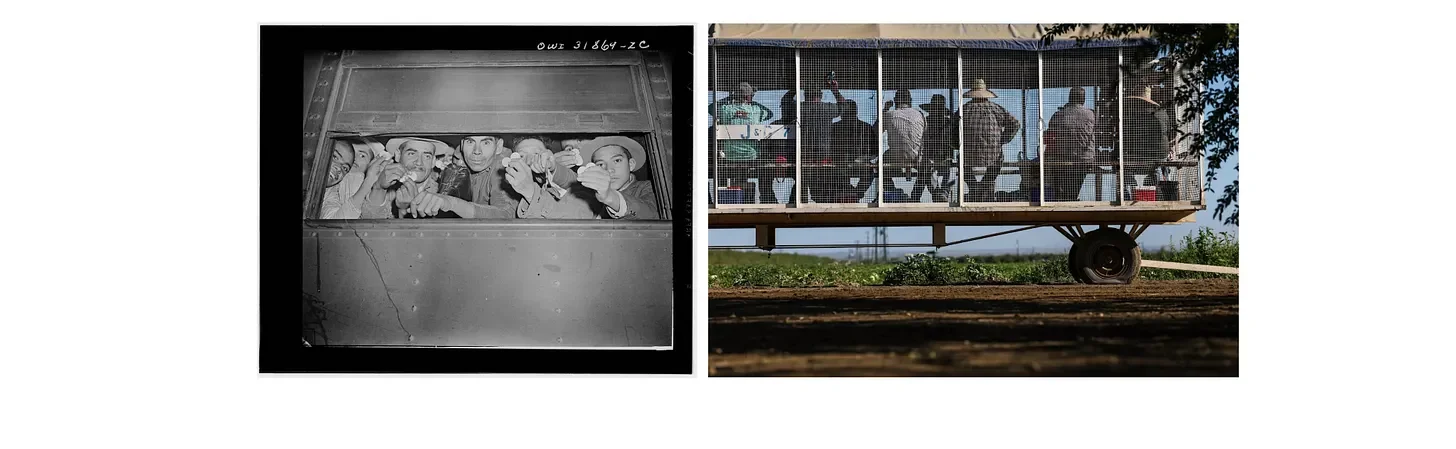
Farmworkers in 1943 versus Farmworkers in 2025
Since his first term, President Donald Trump’s administration has made it a priority to tackle “illegal” immigration. Since his second term, social media and the news has captured an alarming amount of footage containing the murder of U.S. citizens, the arrests of Latines, and the deportation of thousands because of U.S. Immigration and Customs Enforcement (ICE).
As of April 9, 2026, NBC News has tracked 60,311 migrants in ICE detention centers. Of those in detention centers, 26.4% of the migrants had criminal convictions. With easy accessibility to social media, people who have never been exposed to ICE or stories of deportation are witnessing emotional, devastating videos of families being separated because of ICE.
What the current administration is conducting is not new. Aside from just deporting thousands of immigrants, the Trump administration is in the process of trying to recreate the Bracero Program. This is possible because of the H-2A Agriculture Visa Program.
H-2A Agriculture Visa Program
The H-2A Agriculture Visa Program allows U.S. employers to hire temporary workers from abroad, with most of them coming from Mexico. The program is for agricultural jobs that aren’t filled by domestic workers. Once employers prove there are no U.S. workers to hire, there is no limit to how many workers abroad can be hired for agricultural work.
The Trump administration has been working to cut the wages of all farmworkers, estimating that these workers would lose between $4.4 to $5.4 billion a year. The new interim rule in play will split the H-2A workers into two tiers. The rule would result in 92% of farmworkers being categorized as “unskilled,” lowering their pay to the 17th percentile of average wages. These frameworks would earn what the bottom 17% of Americans make.
Although the administration acknowledges they need more farmworkers and people to take up laborious jobs, the administration is tracking down and deporting immigrants across the country for “America’s safety.” The government cannot simultaneously want more non-American farmworkers, while deporting those same communities.
Again, the situation with farmworkers is not new. As the Bracero Program occurred between 1942–1964, Former President Dwight D. Eisenhower created Operation Wetback. Operation Wetback, a derogatory racial slur originally used against Mexican immigrants who crossed the Rio Grande border (their backs wet), deported up to one million Mexicans.
The Bracero Program and Operation Wetback
Farmworkers in the field 1943 versus Farmworkers in the field 2020.
Between 1942–1964, the Bracero Program was created in response to labor shortages during World War II. With Mexico and the United States working together, under short-term labor contracts, Mexican men were sent to the U.S. to work legally in agriculture. At the end of the program, it is estimated there were four million Braceros working in the United States for agriculture and railroads.
What came from the program was millions of Mexican immigrants coming into the United States, both undocumented and documented. As a part of the contract, the laborers were guaranteed access to shelter, food, sanitation, and were paid the minimum wage. However, due to the limits that were placed on the Bracero Program, many employers were willing to hire cheaper, undocumented laborers to get more work done.
Although all these guarantees were promised, the Braceros faced cruel conditions.The Braceros still faced discrimination in the U.S. They had bad wages, deducted pay, surcharges for their rooms, and exposure to deadly chemicals. During the Bracero Program, there were no safeguards concerning pesticides, which led to various health issues over time. That is a reason why farmers or agricultural workers don’t rub or touch their face after handling farmwork because the pesticides, fertilizers, and other bacteria can contaminate your skin, face, and body.
Working under the heat for hours, alongside racism and bad working conditions, Braceros only mattered to the United States for labor reasons. Once they did their work, the United States did not care for their well-being: a pattern the United States will continue to conduct under the current administration.
The fruits and vegetables in grocery stores, the food we make using those ingredients, the juices we drink and consume are all made possible by farmworkers. Beginning with enslaved Africans, to waves of immigrants, from Braceros to Manongs, from Larry Itliong to Dolores Huertas, these workers and people made our current living conditions possible. The changes to the H-2A Agriculture Visa Program is an echo of the government’s exploitative past. How much longer will the government continue to depend on farmworkers while continuing to abuse their willingness to work?