
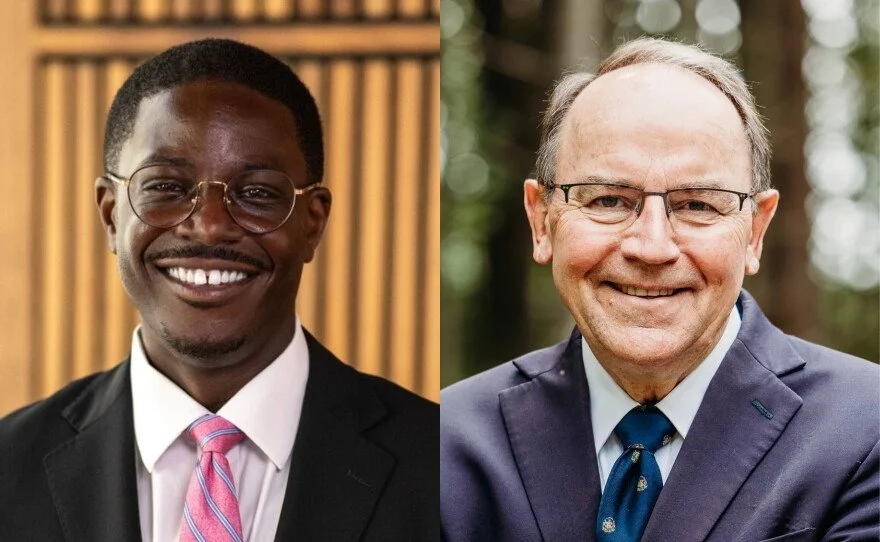
Scrambling for the Seat: A Look Into the Wisconsin Gubernatorial Election
By Taylor Malec
With the wave of midterm elections coming in November, Wisconsin has one of the most important elections in the country – the governor’s race.
The governor seat is open as Governor Tony Evers announced in July 2025 he would not seek a third term, ending months of speculation about his plans and setting off a crowded scramble in both parties to succeed him according to the New York Times.
As a swing state, Wisconsin is no stranger to close elections. In the 2024 presidential election, President Donald Trump and Vice President JD Vance won by just 29,371 votes, a margin of 0.86 percent, making it the closest state in the country that year.
The same is showing up in this year's governor election where Democrat David Crowley and Republican Tom Tiffany are running close in recent polls. The most recent poll from Marquette University Law School has Crowley leading Tiffany 49 percent to 44 percent among likely voters, but the race is tied at 44 percent each among registered voters.
This comes after a shocking Democratic primary where poll-leader and Democratic Socialist Francesca Hong lost to moderate David Crowley by a margin of less than half a percentage point. After the loss, she conceded gracefully and vowed to help Crowley campaign.
About the Candidates
Tom Tiffany is a politician and businessman from Elmwood, Wisconsin. He attended the University of Wisconsin – River Falls, where he studied agricultural economics, and after completing college, Tiffany had several business ventures, including in the petroleum and excursion-boat industries.
His first foray into politics came in 2004 and 2008 when he ran and lost twice for the 12th district seat in the Wisconsin State Senate. His first government role ended up being local: town supervisor of Little Rice, Wisconsin.
Tiffany was not done with statewide politics, though. In 2010, he ran for the 35th district seat in the Wisconsin State Assembly, winning with 58 percent of the vote. In 2012, he ran again for the Wisconsin State Senate, this time winning by about 16 points.
Tiffany was elected into the United States House of Representatives in a special election in 2020, which is a seat he still holds.
David Crowley is a career politician. He first attended University of Wisconsin – Milwaukee, leaving after his first semester and returning years later to finish his degree. Early on, he worked
with the community organizing group Urban Underground, served as a Public Ally, and worked with the nonprofit Project RETURN.
Crowley’s first involvement in politics was working on Senator Russ Feingold’s reelection campaign. Afterward, he joined Milwaukee County supervisor Nikiya Harris Dodd as a legislative aide, a role that led to a promotion to policy director when she was elected to the Wisconsin State Senate.
He lost his first campaign for Milwaukee Common Council in 2016, but he did not give up – just a year later he ran for the 17th Assembly District seat and won, running unopposed in the general election.
In 2019, Crowley ran for Milwaukee County Executive in a tight race, ultimately winning by only about 1,000 votes. In 2020, he was sworn in and remains in this position today.
No Debate – For Now
Wisconsin voters won’t get the debate they’re used to. The Wisconsin Broadcasters Association, which has hosted a gubernatorial debate for 36 straight election cycles, canceled its planned October 9th debate after one of the candidates failed to accept the invitation. The candidate who did not accept the invitation has recently been revealed as Tom Tiffany. It’s the first time in the WBA’s history that it won’t host one.
Voters will still get a chance to see the two face off on October 21st, where Tiffany and Crowley are scheduled to debate on WISN-TV.
Data Centers: The Issue Nobody Expected
If there’s one issue that’s come to define this race, its data centers. Marquette’s polling director Charles Franklin has called it one the fastest shifts in public opinion the poll has measured in 15 years: opposition to data centers among registered voters jumped from 55 percent last October to 78 percent by this August, with remarkably little differences between Republicans, independents, and Democrats.
Despite that, only about 5 percent of voters name data centers as the single most important issue facing the state – inflation and cost of living dominate at 43 percent. Even Franklin has said he can’t fully square that gap.
Both campaigns have tried to capitalize on the backlash. Tiffany, who supported a federal bill to speed data center construction as recently as January, reversed course by May and began calling for the repeal of state tax breaks that draw data centers to Wisconsin. His campaign has run ads branding Crowley “Data Center David” over comments Crowley made in 2025 about Wisconsin’s potential as an AI hub.
Crowley has since shifted to a tougher stance of his own, arguing that local communities should have veto power over proposed projects and that developers – not ratepayers – should cover infrastructure costs.
Underneath the attacks, the two candidates actually agree on quite a bit: both oppose a full moratorium on data center construction, and both back banning nondisclosure agreements between developers and local governments and giving communities a local veto. Where they differ is that Crowley won’t commit to clawing back the tax breaks already on the books – the detail Tiffany has focused his attacks on.
Policies:
Listed are all the policies mentioned on the candidates' websites exactly as listed
Tiffany
● Lower property taxes
● Deliver a 10% working families income tax cut
● End taxes on tips and overtime
● Return the surplus of tax revenue to Wisconsinites
● Prevent sales tax hikes
● Lower gas prices by repealing minimum markup
● Create good-paying jobs
Crowley
● Jobs and wages that build futures by revitalizing store fronts, activating commercial corridors, and creating jobs block by block
● Expanding the middle class by modernizing and expanding apprenticeship programs ● Streamline permitting across state agencies, cut red tape for local entrepreneurs, and expand access to affordable capital.
● Investments in housing, health care, and climate resilience
● Build and preserve affordable housing in rural, urban, and suburban communities ● Universal early childhood education, new investments in public schools, and closing the special education reimbursement gap.
● Invest in solar, energy retrofits, and clean infrastructure
● Close broadband gap, repair roads, and expand transit
● Ensure local governments have the tools and funding to serve their residents while lowering property taxes and re-empowering local decision-making
● Protect voting rights, push for nonpartisan redistricting at every level, and strengthen systems to ensure every voice is heard
● Long-term investments that stabilize providers and expand early childhood programs ● Investments in home and community-based services and strengthen the direct care workforce through better wages and benefits for people with disabilities
Endorsements
(Endorsements below have been compiled from various reporting and campaign sources)
Tiffany
● President Donald Trump
● Dairy Business Association
● Wisconsin Farm Bureau Federation
● Concerned Veterans for America
● Driving Force Action
● See more at the linked website
Crowley
● Wisconsin Governor Tony Evers
● Senator Tammy Baldwin
● Congresswoman Gwen Moore
● Wisconsin AFL-CIO
● Professional Firefighters of Wisconsin
● Wisconsin Laborers’ District Council
● IBEW Wisconsin State Conference
● Operating Engineers Local 139
● Plumbers Local 75
● See more on his website
Remember to register to vote. Check your registration here!