An Honest Review of the Freedom 250 Grand Prix
By Maggie Crisp
On August 23rd, an IndyCar race was held for the first time ever on the streets of Washington, D.C. by order of President Trump to round out celebrations of America’s 250th anniversary. As a motorsports fan and student of the district, here are my honest impressions after attending the spectacle event.
For those who aren’t familiar, the NTT IndyCar Series is a division of open-wheel car racing, meaning that the vehicles feature a single seat and wheels outside the body. It is most well known for the Indianapolis 500, held each Memorial Day weekend. Although Indycars have raced overseas in the past, today’s schedule is limited to North American tracks.
While IndyCars may resemble the cars of the ever-popular Formula One, a key difference is that they race on both ovals tracks as well as road courses. This particular track design has a length of 1.7 miles. In order for the total distance to equal 250 miles, it consisted of 147 laps making it the longest street race in IndyCar history.
With a duration of just under 3 hours, the race was a true test of endurance for drivers and spectators alike. High heat and humidity contributed to health concerns. I can attest that the DC weather was truly stifling, and there wasn’t a lot of shade along the track.
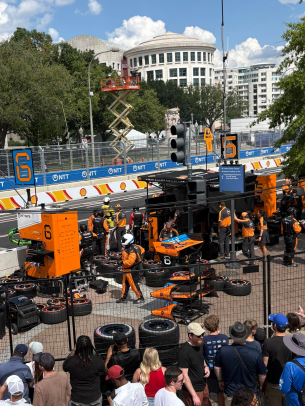
The pit lane was placed alongside Pennsylvania Avenue. Views were limited for those who did not purchase a paddock pass. However, I was able to catch a glimpse at the pit crews for drivers Nolan Siegel and Pato O’Ward.
Arrow McLaren pit stall on Sunday, Aug. 23, 2026, during the Freedom 250 Grand Prix (Photo/Maggie Crisp)
In terms of logistics, the race was surprisingly coherent despite its extremely rushed planning and execution. Trump’s executive order went out at the end of January, meaning that there was only roughly 7 months for them to coordinate the event.
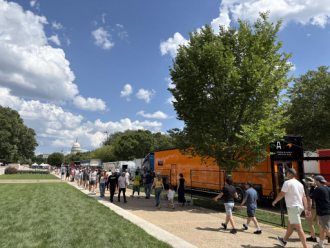
Heavy security included a clear-bag policy and TSA-style checkpoints to enter the ticketed areas which were entirely barricaded off with tall metal fencing. As difficult as it was to get inside, getting out of the race was somehow even harder, with massive crowds bottlenecked into viewing spots.
Attendees walk down the National Mall near the steps of the National Gallery of Art on Sunday, Aug. 23, 2026, during the Freedom 250 Grand Prix (Photo/Maggie Crisp)
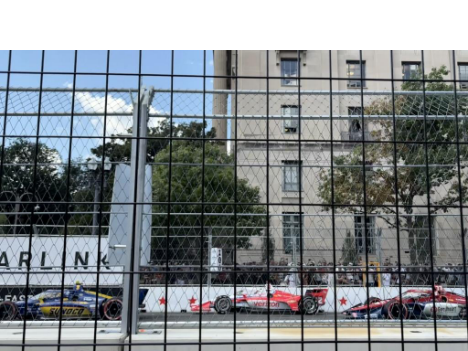
Bridges over the track only allowed crossings at certain times, which meant long lines for attendees attempting to leave from inside. Directions and signage could have been improved, particularly for out-of-town visitors. Viewing could be difficult considering the extensive barricades to protect attendees from debris.
Critics of the event have argued that it was a method for members of the president’s administration to promote nationalist ideals while calling attention to himself and his policies. It is also worth noting unusual sponsors, including several defense-related consultants like Booz Allen Hamilton and Forterra, as well as technology companies such as Elon Musk’s Starlink. The Drug Enforcement Administration and Border Patrol also had a presence.
Despite its heavy politicization, it was a largely enjoyable experience as my first ever IndyCar race. While I am primarily an enjoyer of NASCAR, it was incredible to hear the high-pitched roar of the hybrid engines and witness the speeds of up to 185 mph. Kyle Kirkwood ultimately took home the win in the Andretti Global Honda, after dominating the race and leading 128 laps.